 العربية
 Official Egypt Distributor
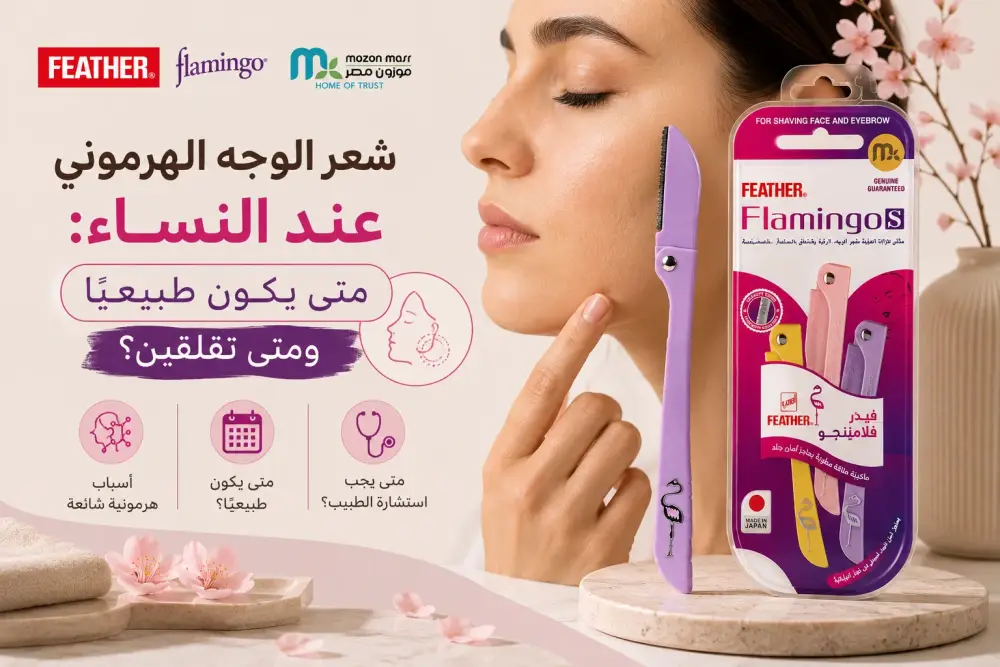
Coarse or Hormonal Facial Hair in Women: When Is It Normal and When Should It Be Assessed?
Facial hair is normal. Most women have fine, lightly pigmented hair across the cheeks, forehead, and upper lip, and some also have several more visible hairs around the chin or jawline.
However, new coarse dark hair, rapid progression, or facial hair accompanied by menstrual changes, severe acne, scalp hair thinning, or other symptoms may deserve medical assessment rather than cosmetic removal alone.
Not every facial hair is “hormonal,” and facial hair alone cannot diagnose polycystic ovary syndrome or another endocrine condition. This guide explains the difference between normal peach fuzz and coarse terminal hair, the signs that warrant evaluation, and the limits of cosmetic hair-removal methods.
Normal Peach Fuzz vs. Coarse Terminal Hair
Vellus Hair
Vellus or peach-fuzz hair is generally:
- Fine and soft.
- Relatively short.
- Lightly pigmented.
- Naturally present across most of the face.
Its presence does not indicate a hormonal problem. It may simply be more visible because of hair color, skin tone, lighting, or genetics.
Terminal Hair
Terminal hair is generally:
- Thicker and coarser.
- More deeply pigmented.
- Longer and more noticeable.
- Structurally more similar to eyebrow or scalp hair than peach fuzz.
A small number of terminal hairs around the chin or upper lip may occur with age or family pattern and does not by itself prove that a medical disorder is present.
What Is Hirsutism?
Hirsutism is the medical term for excessive terminal hair growth in women in an androgen-sensitive distribution, which may include:
- The chin and upper lip.
- The chest.
- The central abdomen.
- The back.
- The thighs in some cases.
It cannot be diagnosed from one photograph or one isolated hair. Assessment considers the pattern, speed of progression, associated symptoms, medical history, and medication use.
Is All Coarse Facial Hair Caused by a Hormonal Disorder?
No.
More visible facial hair may be associated with:
- Genetics and family pattern.
- Ageing or the menopausal transition.
- Increased follicle sensitivity to normal androgen levels.
- Certain medicines or supplements.
- Conditions that alter androgen production or activity.
- No identifiable disorder despite otherwise normal evaluation.
It is therefore not appropriate to assume PCOS or thyroid disease from chin hair alone.
Is PCOS Always the Cause?
PCOS is a recognized cause of hirsutism, but it is not the only cause.
PCOS may be associated with a combination of:
- Irregular or absent menstrual periods.
- Acne.
- Increased facial or body hair.
- Scalp hair thinning.
- Difficulty becoming pregnant in some women.
- Metabolic changes or difficulty managing weight in some cases.
One symptom is not enough for diagnosis. PCOS assessment may include medical history, examination, laboratory testing, and sometimes imaging depending on the individual case.
When May Facial Hair Be Part of Normal Variation?
A change is generally less concerning when:
- It develops slowly over years.
- Women in the family have a similar pattern.
- Only a limited number of hairs are present.
- There are no menstrual or other associated symptoms.
- Hair is not rapidly increasing or spreading to new areas.
You may still request assessment when the hair is distressing or affects your quality of life, even when no warning sign is present.
When Should You See a Clinician?
Speak to a gynecologist, dermatologist, primary-care clinician, or endocrinologist if you notice:
- Sudden onset or rapid progression over weeks or a few months.
- Dark, coarse hair spreading across the chin, chest, abdomen, or back.
- Irregular or absent periods without a known explanation.
- Severe or newly developed acne with increased hair.
- Noticeable scalp hair thinning.
- Voice deepening, rapid muscular changes, or other unusual features.
- Fertility difficulty alongside other androgen-related symptoms.
- A change beginning after a new medicine or supplement.
- Rapid growth at a very young age or after menopause.
These signs do not automatically mean a serious condition is present, but they justify assessment of the cause rather than hair removal alone.
Does Rapid Growth Need Prompt Assessment?
Arrange medical assessment without unnecessary delay when coarse hair develops rapidly, particularly with:
- Voice changes.
- Severe acne.
- Rapid scalp hair loss.
- Marked muscular changes.
- Major menstrual disruption.
Slow progression over years is different from a significant change over a short period.
Can Medication Cause Facial Hair?
Some medicines and supplements may affect hair growth or hormone activity, but the cause cannot be determined from a broad medication category alone.
Tell the clinician about:
- All prescription medicines.
- Hormonal supplements.
- Bodybuilding or performance supplements.
- Long-term steroid or corticosteroid use.
- Any product started before the change appeared.
Do not stop prescribed treatment without medical advice. Discuss the timing and symptoms with the prescriber.
Can Hormonal Contraception Increase or Reduce Facial Hair?
Hormonal contraceptives differ in formulation and effect. Some types may be medically prescribed to help androgen-related symptoms in selected patients.
It is not accurate to say that all contraceptives increase or reduce facial hair.
If a change begins after starting a new method:
- Record when the change started.
- Do not stop contraception without advice.
- Ask the prescriber to assess the relationship and possible alternatives.
What About Pregnancy and Postpartum Changes?
Hair-growth cycles may change during pregnancy and after delivery, but the pattern and duration vary widely.
Do not assume that every new facial hair during pregnancy is temporary or promise a fixed postpartum recovery date.
Seek advice when growth is:
- Severe or rapid.
- Associated with other symptoms.
- Continuing to increase rather than stabilizing.
- Causing significant concern.
Also read our guide to facial hair removal and dermaplaning during pregnancy.
What About Perimenopause and Menopause?
Some women notice more chin or upper-lip hair as the balance of hormones changes during and after the menopausal transition.
This may be part of age-related variation, but rapid, severe, or otherwise symptomatic growth still deserves assessment.
Is Body Weight the Cause of Facial Hair?
Facial hair should not be reduced to body weight or framed as the patient’s fault.
Some endocrine and metabolic conditions can influence weight and hair at the same time, but:
- Hirsutism can affect women at any body weight.
- Weight alone does not identify the cause.
- A diagnosis cannot be inferred from appearance.
Clinical assessment considers the complete pattern rather than using weight as the sole explanation.
Can Stress Cause Hormonal Facial Hair?
There is no reliable rule that chronic stress alone directly causes hirsutism.
Stress may affect sleep, menstrual cycles, and health behaviors, but it should not be used to explain rapid hair change without considering other causes.
Tell the clinician about major stress alongside menstrual or physical changes as part of the complete history.
How Is the Cause Assessed?
Evaluation may include:
- When hair growth began and how quickly it progressed.
- The distribution of the hair.
- Menstrual history.
- Medication and supplement use.
- Acne, scalp hair loss, and other changes.
- Family history.
- Physical examination.
- Hormone tests or other investigations when appropriate.
Not every patient requires the same tests. The clinician selects investigations according to symptoms, age, and medical history.
Can You Remove the Hair While Waiting for Assessment?
Yes. Cosmetic hair removal generally does not prevent medical assessment.
Before the appointment, it may help to:
- Record when the change started.
- Take private progress photographs if you are comfortable doing so.
- Write down associated symptoms.
- Bring a complete medicine and supplement list.
You do not normally need to leave the hair untreated for a prolonged period unless the clinician specifically requests this for examination.
What Can Hair-Removal Methods Do?
Hair-removal techniques manage visible hair. They do not treat a possible endocrine cause.
Dermaplaning or Facial Shaving
A facial razor cuts hair at the skin surface and does not reach the follicle.
It may be useful for peach fuzz or visible surface hair, but it:
- Does not alter hormone levels.
- Does not stop new hair from developing.
- Does not treat PCOS or another medical condition.
- Must be repeated as hair returns.
Use it only on calm skin with a clean tool and light pressure.
Threading and Tweezing
These methods remove hair from the root and may produce a longer hair-free interval, but they can cause pain, follicular irritation, or ingrown hairs.
Read our threading vs. dermaplaning comparison.
Waxing
Waxing removes hair from the root but may cause irritation, surface injury, or post-inflammatory pigmentation in susceptible skin.
Read our waxing vs. dermaplaning comparison.
Laser Hair Removal
Laser may produce long-term reduction in suitable darker, coarser hair, but it does not treat the hormonal cause.
New follicles may continue to produce hair while hormonal stimulation continues, and some women require maintenance treatments.
Read our laser hair removal vs. dermaplaning comparison.
Medical Treatment
A clinician may recommend treatment for the underlying condition or medicine that slows hair growth, depending on the diagnosis and medical circumstances.
Do not use another person’s hormonal medicine or prescription cream and do not request a specific treatment solely on the basis of a general article.
Does Shaving Make Facial Hair Thicker?
No. Shaving and dermaplaning do not increase the number of follicles or alter the true growth rate, color, or diameter of hair.
After cutting, the tip is blunt instead of naturally tapered. This can make early regrowth feel or appear more noticeable, but the hair has not become thicker at the root.
Does Tweezing Reduce Hair Permanently?
Repeated tweezing cannot be relied on to produce permanent reduction.
Some follicles may change after prolonged removal while others do not. Tweezing may also contribute to:
- Follicular inflammation.
- Ingrown hairs.
- Redness or dark marks.
- Surface damage from repeated picking.
Does Laser Permanently Treat Hormonal Facial Hair?
Laser does not change hormone levels or cure the underlying condition.
It may reduce responsive hairs in treated follicles, but ongoing hormonal stimulation can lead to:
- New hair growth.
- Additional treatment requirements.
- Partial regrowth over time.
For some patients, the most effective strategy combines assessment and treatment of the cause when appropriate with a suitable visible-hair-removal method.
When May Dermaplaning Be a Practical Option?
A facial razor may be practical when:
- Hair is fine or superficial.
- You want a quick temporary result.
- Your skin tolerates facial-razor use.
- There is no inflamed acne, rash, or broken skin.
- You are not using it as a substitute for assessing a new or rapid change.
For correct technique, read our complete dermaplaning guide and step-by-step at-home guide.
When Is Dermaplaning Not Appropriate?
Avoid it when you have:
- Deep or inflamed acne.
- Open wounds or sores.
- A skin infection.
- An active eczema or rosacea flare.
- An unexplained rash.
- Severe irritation or sunburn.
If your skin is reactive, read our guide to dermaplaning for sensitive skin.
Choosing a Facial Razor for Peach Fuzz
When facial-razor use is appropriate for your skin, choose a dedicated tool from a trusted source.
The original Feather Flamingo S facial razor has a fine protective guard and foldable handle designed for short, controlled peach-fuzz-removal strokes across the cheeks, forehead, and jawline.
No razor completely prevents irritation or cuts. Use light pressure, avoid inflamed skin, and replace the razor when damaged or no longer gliding smoothly.
Read our guide to guarded facial razors for peach fuzz removal.
Original Feather Japan products are available through Mozon Masr, the official distributor of Feather Japan in Egypt and North Africa since 2020.
Frequently Asked Questions
Does chin hair mean I have PCOS?
No. Chin hair may be associated with genetics, age, follicle sensitivity, or several other causes. PCOS cannot be diagnosed from facial hair alone.
What is the difference between peach fuzz and hirsutism?
Peach fuzz is fine vellus hair naturally found on the face. Hirsutism describes coarse terminal hair in an androgen-sensitive pattern and may need assessment when new, severe, or associated with other symptoms.
When should I see a doctor about facial hair?
Seek assessment for sudden onset, rapid progression, menstrual changes, severe acne, scalp hair thinning, voice changes, or other unusual symptoms.
Can I remove the hair before a medical appointment?
Usually yes. Record the timing and associated symptoms, and consider private progress photographs if you are comfortable doing so.
Does dermaplaning treat hormonal facial hair?
No. It removes visible surface hair only and does not alter hormone levels or follicle activity.
Does shaving make facial hair thicker?
No. Early regrowth may look more noticeable because the tip is blunt, but shaving does not increase follicle number or true hair diameter.
Is laser a permanent solution for hormonal facial hair?
It may reduce responsive hairs, but it does not treat the hormonal driver. Maintenance treatment or medical management may still be required.
Does postpartum facial hair always disappear?
No fixed outcome or timeline applies to everyone. Severe, increasing, persistent, or otherwise symptomatic growth deserves assessment.
Can dark facial hair still be normal?
Yes. Several dark hairs may be part of a normal family pattern. The number, distribution, speed of change, and associated symptoms are more informative than color alone.
Is it reasonable to seek treatment simply because the hair bothers me?
Yes. Facial hair is common, and its psychological impact is valid. You may request evaluation, treatment, or cosmetic removal because it affects your comfort or confidence.
Conclusion
- Fine facial peach fuzz is normal and does not indicate a hormonal disorder.
- Hirsutism describes coarse terminal hair in a particular distribution and is not a synonym for all facial hair.
- PCOS is one possible cause but cannot be diagnosed from hair alone.
- Sudden, rapid, or symptomatic growth deserves medical assessment.
- Shaving and dermaplaning do not make hair grow thicker.
- Cosmetic removal manages visible hair but does not treat an underlying cause.
- Laser may reduce hair but does not stop hormonal stimulation.
- You can manage visible hair while the cause is being evaluated.
For at-home peach-fuzz removal, read our complete dermaplaning guide and use a dedicated facial tool only when the skin is calm.
Learn more about the original Feather Flamingo S facial razor through Mozon Masr, the official Feather distributor in Egypt and North Africa.