 العربية
 Official Egypt Distributor
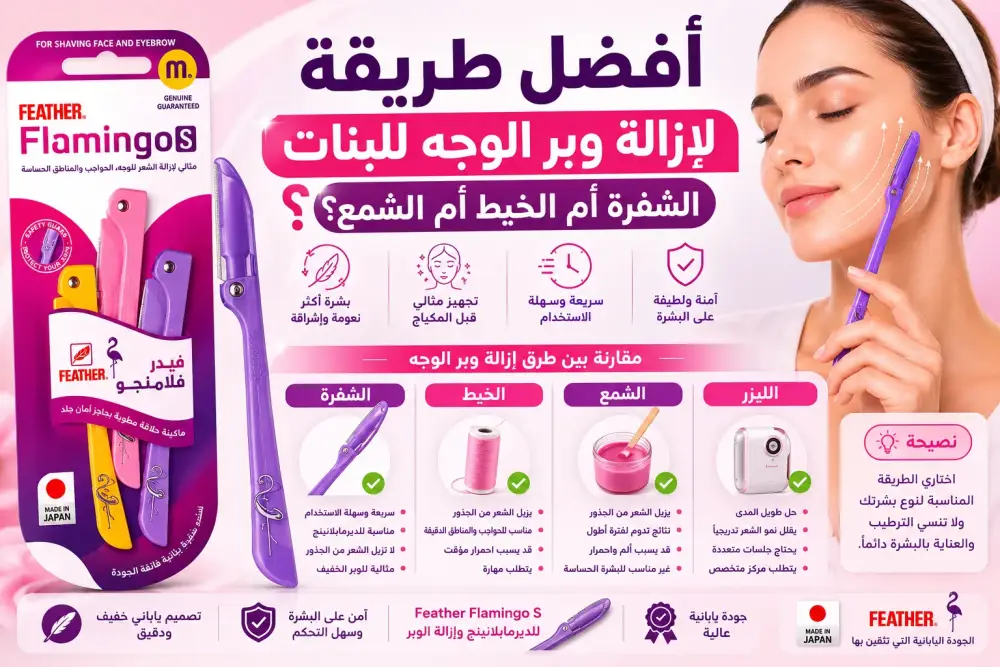
Best Facial Hair Removal Method for Women: Razor, Threading, Waxing, or Laser?
There is no single facial-hair-removal method that is best for every woman. The correct choice begins with the type of hair: is it fine peach fuzz across the cheeks and forehead, or darker, coarser hair around the chin and upper lip? Skin condition, pain tolerance, desired result duration, budget, and any laser-treatment plan also matter.
Some methods cut hair at the skin surface, including facial shaving and dermaplaning. Others remove hair from the root, including threading, waxing, and tweezing. Laser hair removal has a different objective: long-term reduction of suitable hair rather than immediate cosmetic removal alone.
This guide compares the most common methods, explains when each may be practical, and identifies situations in which hair removal should be postponed or medical assessment considered.
If your main concern is peach fuzz, begin with our complete dermaplaning and peach-fuzz-removal guide.
Start by Identifying the Hair Type
Fine Peach Fuzz
Vellus or peach-fuzz hair is generally:
- Fine and soft.
- Relatively short.
- Lightly pigmented.
- Naturally present across the cheeks, forehead, and jawline.
Peach fuzz is normal and does not indicate a hormonal disorder. It may be removed for cosmetic reasons, but there is no medical requirement to remove it.
Coarse Terminal Hair
Terminal hair is thicker, longer, and more deeply pigmented. It may appear around the chin, upper lip, or jawline.
This may be part of a normal family pattern. However, sudden or rapidly progressing coarse hair, particularly with menstrual irregularity, severe acne, or scalp hair thinning, deserves medical assessment.
Read our guide to coarse or hormonal facial hair in women.
Quick Facial-Hair-Removal Comparison
| Method | How It Removes Hair | Result Duration | Primary Use | Main Limitations |
|---|---|---|---|---|
| Facial razor | Cuts hair at the skin surface | Temporary; hair returns with natural growth | Peach fuzz and relatively large facial areas | May cause cuts or irritation with poor technique |
| Dermaplaning | Cuts peach fuzz and removes some superficial buildup | Temporary | Peach fuzz and a smoother-looking surface before makeup | Unsuitable for inflamed or broken skin |
| Threading | Pulls hair from the root | Usually longer than shaving | Eyebrow shaping and precision areas | Pain, redness, and possible follicular irritation |
| Waxing | Removes groups of hairs from the root | Usually longer than shaving | Rapid removal from multiple facial areas | May irritate or injure the skin surface |
| Tweezing | Removes individual hairs from the root | Until each hair regrows | A limited number of isolated hairs | Slow and may cause ingrown hairs or inflammation |
| Depilatory cream | Breaks down hair near the skin surface | Temporary | Fast removal without a blade | May cause chemical irritation or burns |
| Laser hair removal | Targets pigment within the hair and follicle | Long-term reduction after multiple sessions | Suitable darker, coarser hair | Not suitable for every hair color and does not treat hormonal causes |
Removing Facial Hair With a Razor
A facial razor cuts the visible hair shaft at the skin surface without removing the root. The result is immediate, but hair becomes visible sooner than after root-removal methods.
Advantages of a Facial Razor
- Immediate results.
- No need to wait for hair to reach a specific length.
- Can be used at home.
- Practical for the cheeks, forehead, and jawline.
- Does not extract the follicle required during many laser-treatment plans.
Limitations and Risks
- Hair becomes visible sooner than after waxing or threading.
- Small cuts and scratches may occur.
- Pressure and repeated passes may cause redness, dryness, or bumps.
- Use over acne or damaged skin may increase irritation.
Shaving does not make hair thicker, darker, or faster-growing. Early regrowth may feel rough because the hair was cut with a flat tip, but the follicle itself has not changed.
Read Does shaving peach fuzz make facial hair grow back thicker?
Facial Shaving vs. Dermaplaning
Both cut hair at the surface. At-home dermaplaning generally refers to using a dedicated facial razor with short, controlled strokes to remove peach fuzz and some superficial buildup.
This may help:
- Create temporarily smoother-feeling skin.
- Reduce the visibility of peach fuzz under lighting.
- Help foundation appear more even.
- Allow skincare products to spread more easily.
Dermaplaning is not a treatment for acne, pigmentation, pores, or another skin disease, and it is not completely risk-free or suitable for every skin type.
For detailed technique, read our step-by-step at-home dermaplaning guide.
Removing Facial Hair With Threading
Threading uses twisted thread to catch hairs and remove them from the root. It may offer high precision around the eyebrows when performed by an experienced practitioner.
Advantages of Threading
- Detailed control around the eyebrows.
- Results generally last longer than shaving.
- No wax or depilatory chemicals are required.
- Can remove individual hairs or fine rows.
Limitations of Threading
- May be painful, particularly on the upper lip.
- May cause redness or follicular bumps.
- Results depend on practitioner skill and hygiene.
- Full-face treatment may involve prolonged friction.
- Usually unsuitable during laser courses because it removes the root.
Threading is often more practical for eyebrow shaping, while a facial razor may be more convenient for peach fuzz across the cheeks and forehead.
Read our threading vs. dermaplaning comparison.
Removing Facial Hair With Wax
Wax adheres to facial hair and removes it from the root. It may provide a longer interval before regrowth than surface shaving.
Advantages of Waxing
- Removes multiple hairs quickly.
- Results generally last longer than shaving.
- May be used on several facial areas when the skin is suitable.
Limitations of Waxing
- Pain during root removal.
- Redness or follicular irritation.
- Risk of surface injury, particularly with hot wax or poor technique.
- Possible post-inflammatory pigmentation in susceptible skin.
- Hair must reach sufficient length for the wax to grip.
- It may be unsuitable during certain skincare treatments or laser plans.
Avoid waxing irritated or sunburned skin. Certain medicines and active skin treatments may make the skin more vulnerable to injury, so ask the prescribing clinician or pharmacist before waxing.
Read our waxing vs. dermaplaning comparison.
Removing Individual Hairs With Tweezers
Tweezing is practical for a very small number of isolated hairs, such as one prominent chin hair or limited hairs around the eyebrow.
When Is Tweezing Practical?
- When only several isolated hairs are present.
- For limited eyebrow maintenance.
- When you want a specific hair removed from the root.
When Is Tweezing Impractical?
- For full-face peach fuzz.
- When dense hair requires repeated picking.
- If tweezing repeatedly causes inflammation or ingrown hairs.
- During a laser course when root removal is restricted.
Use clean tweezers and do not dig into the skin or pick at ingrown hairs.
Facial Depilatory Creams
Depilatory creams contain chemicals that break down hair near the skin surface without extracting the follicle.
Advantages
- No sharp blade is required.
- Hair can be removed relatively quickly.
- Products specifically formulated for the face may be used at home.
Limitations
- May cause stinging, inflammation, or chemical burns.
- May be unsuitable for sensitive skin.
- Body depilatory products should not be used on the face.
- A patch test and exact timing are essential.
- Do not apply to broken or inflamed skin.
Do not leave a depilatory cream on longer to obtain a stronger result. Remove it immediately if significant burning develops.
Laser Hair Removal
Laser hair removal uses light energy to target pigment within the hair and follicle for long-term hair reduction.
It is generally most practical for darker, coarser hair when the device and settings are suitable for the skin.
Advantages of Laser
- May reduce the amount and future growth of responsive hair.
- May reduce the need for repeated removal.
- Can be practical for frequently recurring coarse hair.
Limitations of Laser
- Requires multiple sessions.
- Does not guarantee permanent removal of every hair.
- Response varies with hair color, thickness, skin tone, and device.
- Very fine or lightly pigmented hair may be a poor target.
- Maintenance treatments may be required.
- It does not treat an underlying hormonal cause.
Do not begin laser treatment on very fine facial peach fuzz without assessment of the hair and device. Avoid waxing, threading, and tweezing during treatment when the clinic requires the follicle to remain intact.
Read our laser hair removal vs. dermaplaning comparison.
What Is the Best Method for Full-Face Peach Fuzz?
When the hair is fine peach fuzz across the cheeks, forehead, and jawline, a facial razor or dermaplaning may be more practical than threading or tweezing because larger areas can be treated relatively quickly.
You may choose a facial razor when:
- You want an immediate result.
- You do not want root removal.
- You do not want to wait for visible hair growth.
- Your skin tolerates facial-razor use.
- You prefer a quick at-home routine.
It is not appropriate over inflamed acne, wounds, an active eczema flare, or severe irritation.
What Is the Best Method for Eyebrow Shaping?
Threading can provide detailed shaping when performed by an experienced practitioner because it can remove fine rows of hair from the root.
A precision razor may be more suitable for removing limited surface hairs around an established shape, rather than redesigning the entire eyebrow without experience.
The Feather Flamingo M precision facial razor has a smaller head for detailed areas around the eyebrows and upper lip.
Keep the tool away from the eyelid, use clear lighting and short strokes, and do not attempt major eyebrow changes immediately before an event.
What Is the Best Method for the Upper Lip?
The choice depends on your priorities:
- Facial razor: fast and less painful for many users, but hair returns sooner.
- Threading: usually lasts longer but may be painful and cause redness.
- Waxing: removes multiple hairs quickly but may irritate this sensitive area.
- Depilatory cream: avoids a blade but may sting or burn unsuitable skin.
- Laser: may be practical for suitable darker, coarser hair after professional assessment.
Use only a method your skin has previously tolerated, particularly before important events.
What Is the Best Method for Sensitive Skin?
No method is automatically best for sensitive skin.
Sensitive skin may react to:
- Facial-razor friction.
- Root removal with threading.
- Wax adhesion or heat.
- Depilatory chemicals.
- Laser heat or unsuitable settings.
If your skin is sensitive:
- Test the method on a small area.
- Do not treat red or peeling skin.
- Do not try a new method immediately before an event.
- Use the least possible friction and pressure.
- Ask a dermatologist when you have eczema, rosacea, or another diagnosed condition.
Read our guide to dermaplaning for sensitive skin.
What About Acne-Prone Skin?
Do not pass a blade, thread, or wax over inflamed acne.
Hair removal over active acne may:
- Cut or rupture a spot.
- Increase inflammation.
- Spread bacteria across the area.
- Increase the risk of post-inflammatory marks.
Hair may be removed from calm areas while clearly avoiding spots. When inflammation is widespread, postpone facial-hair removal and seek dermatological advice.
Which Method Is Compatible With Laser Treatment?
Laser clinics commonly ask patients to avoid root-removal methods, including:
- Waxing.
- Threading.
- Tweezing.
- Sugaring.
The provider may permit shaving, but may require simple shaving rather than dermaplaning with additional superficial exfoliation.
Ask the clinic:
- Which method is allowed between sessions?
- When should hair be removed before treatment?
- Can a guarded facial razor be used?
- When can hair removal resume afterward?
Do not replace clinic instructions with general internet advice.
Facial Hair Removal During Pregnancy
Skin may become more sensitive or pigmentation-prone during pregnancy, which can change tolerance of a previously familiar method.
A surface-level method is not automatically suitable for every pregnant person. Many providers also postpone cosmetic laser treatment during pregnancy according to their policies and clinical guidance.
During pregnancy:
- Avoid first-time facial-hair-removal experiments immediately before an event.
- Test new products or methods on a small area.
- Read facial depilatory instructions carefully and ask a clinician when uncertain.
- Seek advice when hair becomes rapidly coarser or is accompanied by other changes.
Read our guide to dermaplaning and facial-hair removal during pregnancy.
When Is Cosmetic Hair Removal Not Enough?
Most methods remove visible hair only. Laser may produce long-term reduction in suitable hair, but none of these methods treats a possible hormonal cause.
Seek medical assessment if facial hair becomes:
- Suddenly denser or coarser.
- Rapidly distributed across new areas.
- Associated with irregular menstrual periods.
- Associated with severe or newly developed acne.
- Associated with scalp hair thinning.
- Associated with voice changes or other unusual symptoms.
You can manage visible hair while the cause is assessed, but cosmetic removal should not replace evaluation.
How to Choose the Right Method
Use this practical framework:
- Fine full-face peach fuzz and an immediate result: facial razor or dermaplaning when appropriate for the skin.
- Detailed eyebrow shaping: threading by an experienced practitioner or limited maintenance with a precision razor.
- A few isolated hairs: clean tweezers.
- A longer result with acceptable root-removal discomfort: threading or waxing.
- No sharp tool preferred: a facial depilatory cream after patch testing.
- Dark coarse hair and a long-term objective: laser assessment by a qualified provider.
- New or progressive hair with other symptoms: medical assessment alongside suitable cosmetic management.
Aftercare Following Facial Hair Removal
After shaving, dermaplaning, threading, or waxing:
- Do not rub the treated area.
- Use a gentle moisturizer your skin has previously tolerated.
- Avoid strong acids, retinoids, and exfoliants until the skin settles.
- Do not apply makeup over cuts or severe redness.
- Use broad-spectrum sunscreen during the day.
- Monitor increasing pain, swelling, discharge, or burning.
Read our post-dermaplaning and facial-hair-removal skincare guide.
Choosing a Facial Razor for Peach Fuzz
If a facial razor is the most appropriate option for you, use a dedicated facial tool from a trusted source.
The original Feather Flamingo S facial razor has a fine protective guard and lightweight foldable handle designed for short, controlled strokes across the cheeks, forehead, and jawline.
The Feather Flamingo M precision razor has a smaller head for detailed areas around the eyebrows and upper lip.
No razor completely prevents irritation or cuts. Use light pressure, avoid acne and broken skin, and replace the tool when damaged or no longer gliding smoothly.
Read our guide to choosing guarded facial razors for peach-fuzz removal.
Original Feather Japan products are available through Mozon Masr, the official distributor of Feather Japan in Egypt and North Africa since 2020.
Frequently Asked Questions
What is the best facial-hair-removal method for women?
No single method is best for everyone. Full-face peach fuzz may suit dermaplaning, eyebrows may suit threading, and suitable darker coarse hair may justify laser assessment.
Does shaving make facial hair thicker?
No. Shaving does not increase follicle number, true hair diameter, growth speed, or pigment.
Which lasts longer: shaving or threading?
Threading usually lasts longer because it removes hair from the root, while shaving cuts it at the skin surface.
Which method is gentlest for sensitive skin?
There is no universal answer. Sensitive skin may react to razor friction, threading, waxing, or depilatory chemicals. Patch test and avoid treatment during active irritation.
Can I wax while using retinol?
Some active treatments may make the skin more vulnerable to surface injury. Ask the prescribing clinician or pharmacist before waxing, and do not stop prescribed treatment without advice.
Can I use a facial razor during laser treatment?
The clinic may permit shaving, but it should determine whether dermaplaning is allowed and specify timing. Avoid root removal unless the provider instructs otherwise.
Does laser remove fine facial peach fuzz?
Very fine or lightly pigmented hair may respond poorly. Hair type, skin tone, and device suitability should be assessed first.
Can facial hair be removed over acne?
Do not pass a blade, thread, or wax over inflamed spots because this may cut the acne lesion and worsen inflammation.
What is the best method for hormonal facial hair?
Visible hair may be managed with shaving, threading, waxing, or laser according to suitability, but these methods do not treat the cause. New or progressive hair with other symptoms needs assessment.
Can more than one method be used?
Yes. A different method may be assigned to each area, such as threading for eyebrows and a facial razor for cheek peach fuzz. Avoid combining methods on the same irritated area within a short period.
Conclusion
- No single method is ideal for every woman or every facial area.
- Facial shaving and dermaplaning are often practical for surface peach fuzz and immediate results.
- Threading offers precision around eyebrows but removes hair from the root and may be painful.
- Waxing generally lasts longer but may be more aggressive on the skin.
- Tweezing is suitable for a limited number of individual hairs.
- Depilatory creams require careful patch testing because chemical irritation can occur.
- Laser may reduce suitable dark coarse hair over time but does not work equally on all hair or treat hormonal causes.
- Sudden or progressive coarse hair with other symptoms deserves medical assessment.
If you choose facial-razor use, read our complete dermaplaning guide and follow the correct step-by-step at-home method.
Learn more about the original Feather Flamingo S facial razor and Feather Flamingo M precision razor through the official Feather Egypt authority page.